Zaragoza
Zaragoza is a city in northeast Spain, the capital of the Aragon region and the province of the same name. Located on the Ebro River in the center of a wide valley. Zaragoza is a treasure trove of historical and cultural treasures that are really worth seeing: ancient Roman ruins, majestic ancient churches, beautiful Mudejar-style palaces and museums with masterpieces by Francisco Goi, Serrano and Pablo Gargallo.
Zaragoza is a charming warm city conveniently located between Madrid, Barcelona, Bilbao, Valencia and Toulouse. It is one of Spain's largest cities in population and economy. Zaragoza attracts with its rich culture, shops, delicious food and ancient monuments. This is a city with a 2000-year history that preserves one of the largest historical and artistic heritage on the Iberian Peninsula...
History
Zaragoza was founded by the Romans who called the settlement Colonia Caesaraugusta. The name means "Colony of the Emperor Augustus". For the first time veterans of the Cantabrian wars settled here. Soon Zaragoza became the most important city center of the middle Ebro Valley. In 380 a general Christian synod was held here.
In the early 8th century Zaragoza was conquered by the Arabs. From that time the city was part of the Caliphate of Cordoba and was an important Moorish stronghold in the fight against the Spanish kings. After the collapse of the Cordoba Caliphate Zaragoza became the center of an independent Mauritanian state. In 1118 the city was conquered by the king of Aragon and Navarre and became the capital of the kingdom.
In the 15th century after the unification of Spain Zaragoza lost its importance while remaining one of the most important and major cities in the northeast. During the Napoleonic wars the city became famous for its heroic defense against the French. In the 20th century the economy of Zaragoza began to grow rapidly thanks to industrialization.
Geography and climate
Zaragoza is located in the middle reaches of the Ebro about 300 km from the Spanish capital Madrid. The rivers of Hervva and Gallego flow through the city. The average altitude is about 200 m. Zaragoza has a cold semi-arid climate. The winters here are quite cool with frequent frosts. Summer is dry and hot. There is very little rainfall in the year - about 400 mm most of which fall in April-May and October-November.
How to get there
Zaragoza Airport is located 10 km from the city center. In 2008 a new terminal was built. Aircraft from Alicante, Brussels, London, Rome, Paris, Frankfurt and other cities in Spain and Europe arrive at the airport. You can get from the airport to the city by bus, train and taxi. There are regular high-speed trains from Zaragoza to Barcelona and Madrid. Regular trains connect the city with Bilbao and Valencia. There is a regular bus service with the major cities of Northeast and Central Spain.
Cuisine
Zaragoza is famous for its gastronomy and tapas. Here are some typical Aragon dishes: Bacalao al Ajoarriero - garlic and eggs cod.
Longanizas y Chorizos is a local type of sausage.
Migas a la Aragonesa - A dish with egg and spicy pork sausage (chorizo).
Melocotón con vino - peaches in wine.
Borrajas is a local vegetable with olive oil.
Ternasco Asado - fried lamb.
Cordero A la Pastora - lamb dish.
Huevos al Salmorejo - Eggs with tomato cream.
Pollo al Chilindrón - Chicken in a sauce with tomatoes, onions and paprika.
Zaragoza is a great shopping city. In the central streets are many different shops. The main shopping area extends from Residencial Paraiso to the Plaza of Spain. You can buy souvenirs in the Plaza San Brun area. Behind the football stadium is the largest market in the city.
Shopping
Sights
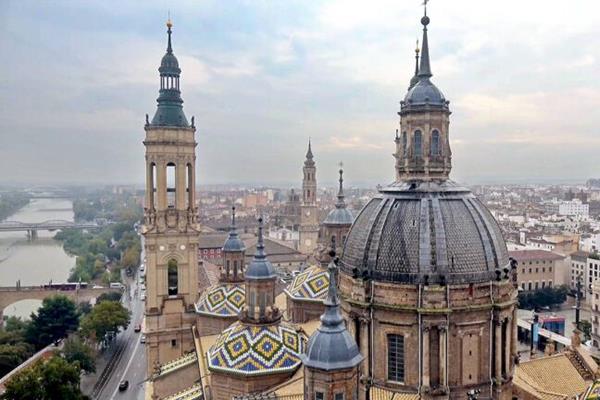
Basilica de Nuestra Señora del Pilar is the grand cathedral and the most famous monument of Zaragoza. This baroque pearl was built between the 17th and 18th centuries on the banks of the river Erbo. The church is located on the Plaza del Pilar - a spacious city square surrounded by historic buildings.
The Basilica is considered to be the first church dedicated to the Virgin Mary and is one of the most important pilgrimage centers in Spain. According to legend the apostle Jacob built a small chapel dedicated to the Virgin which became the first in the Christian world. Later other churches were built on the site which in the 17th century replaced the impressive Baroque building.
The interior of the Basilica de Nuestra Señora del Pilar is striking and contains the most valuable works of art. Inside the Chapel of Santa Capilla, the work of the great Venturo Rodriguez is the image of the Virgin Mary del Pilar. Of particular interest are the Alabaster altar and the murals of Francisco Goya.
The Cathedral of San Salvador or simply La Seo is a grand church built on the site of the Roman Forum. During the period when Zaragoza belonged to the Moors there was a mosque. The tall tower was once a minaret. In the 12th century a Muslim mosque was rebuilt into a Romanesque cathedral. La Seo Cathedral is a huge church with five naves whose two apse with exquisite sculptured arcades retain their original Romanesque character. Arabic influence is observed in the altar and in some arches, while the choir is Gothic in style. Later the church received a neoclassical facade and baroque details on the tower.